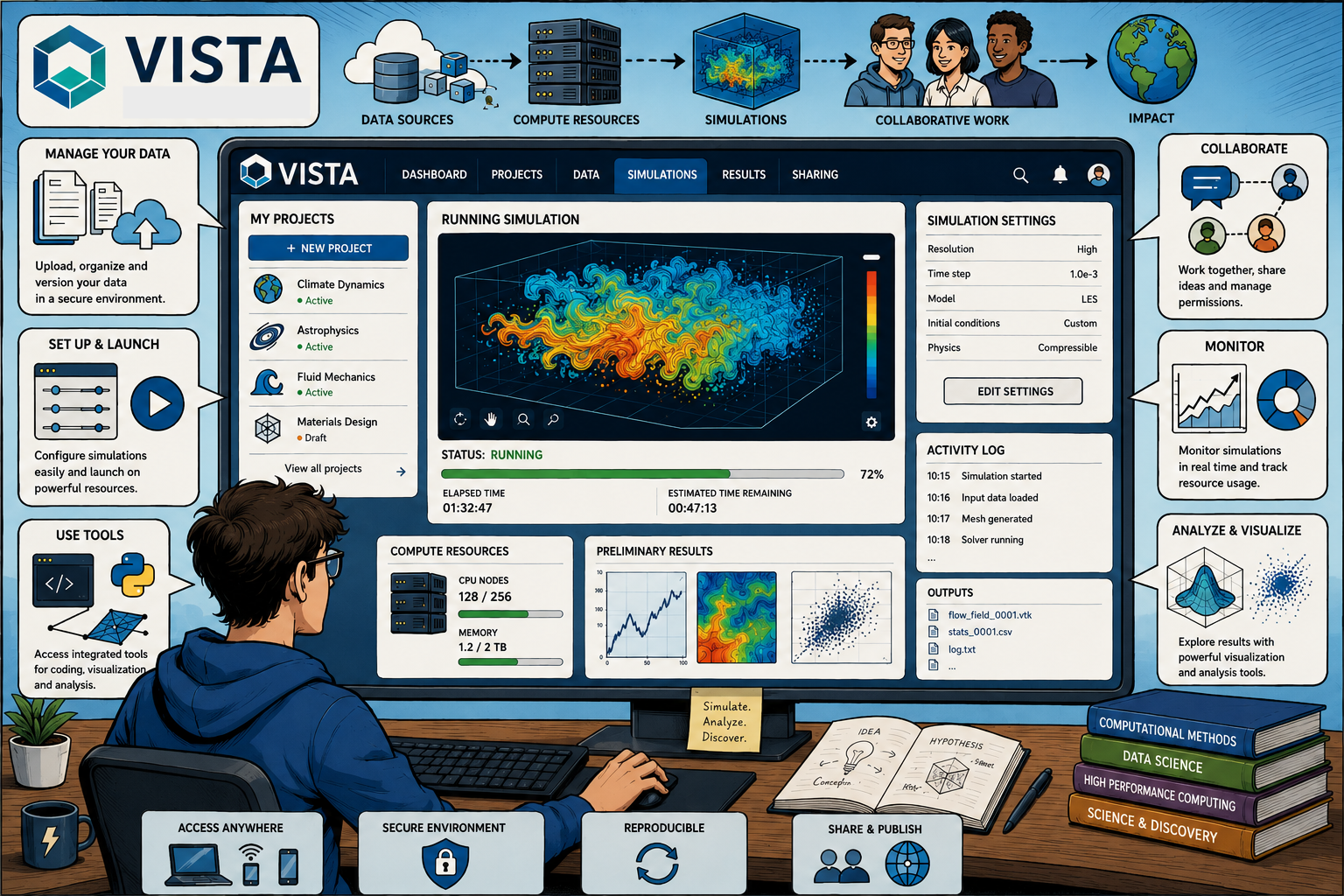
VISTA - Virtual Interactive Visualization, Simulation and Twin Analysis is the interactive platform developed within GEO-DREAM to provide users with a unified environment for accessing, exploring and interacting with the project’s Digital Twins.
Rather than operating as a standalone system, VISTA builds upon and extends the existing IT infrastructure PEOS, developed within the INGV MEET (Monitoring Earth Evolution and Tectonics) PNRR project.
PEOS
PEOS - Platform for Earth Observation from Space provides a common technological environment for the management, organisation, processing and distribution of Earth and Space Observation data and products, integrating thematic scientific modules with shared storage, computational resources and data-access services. Within GEO-DREAM, the PEOS infrastructure will therefore constitute the data and processing backbone supporting the Digital Twin Components and their associated workflows. Existing PEOS thematic modules, together with newly developed GEO-DREAM components, will operate within this common environment, accessing observational datasets, intermediate products and model outputs required by the different Digital Twins.
To meet the additional computational requirements introduced by numerical modelling, artificial intelligence methods and scenario-based simulations, the infrastructure will be enhanced with a dedicated High-Performance Computing (HPC) node. This new computational resource will support the execution of physics-based and data-driven Digital Twin models, enabling computationally intensive processing, repeated simulations and the generation and comparison of alternative scenarios
.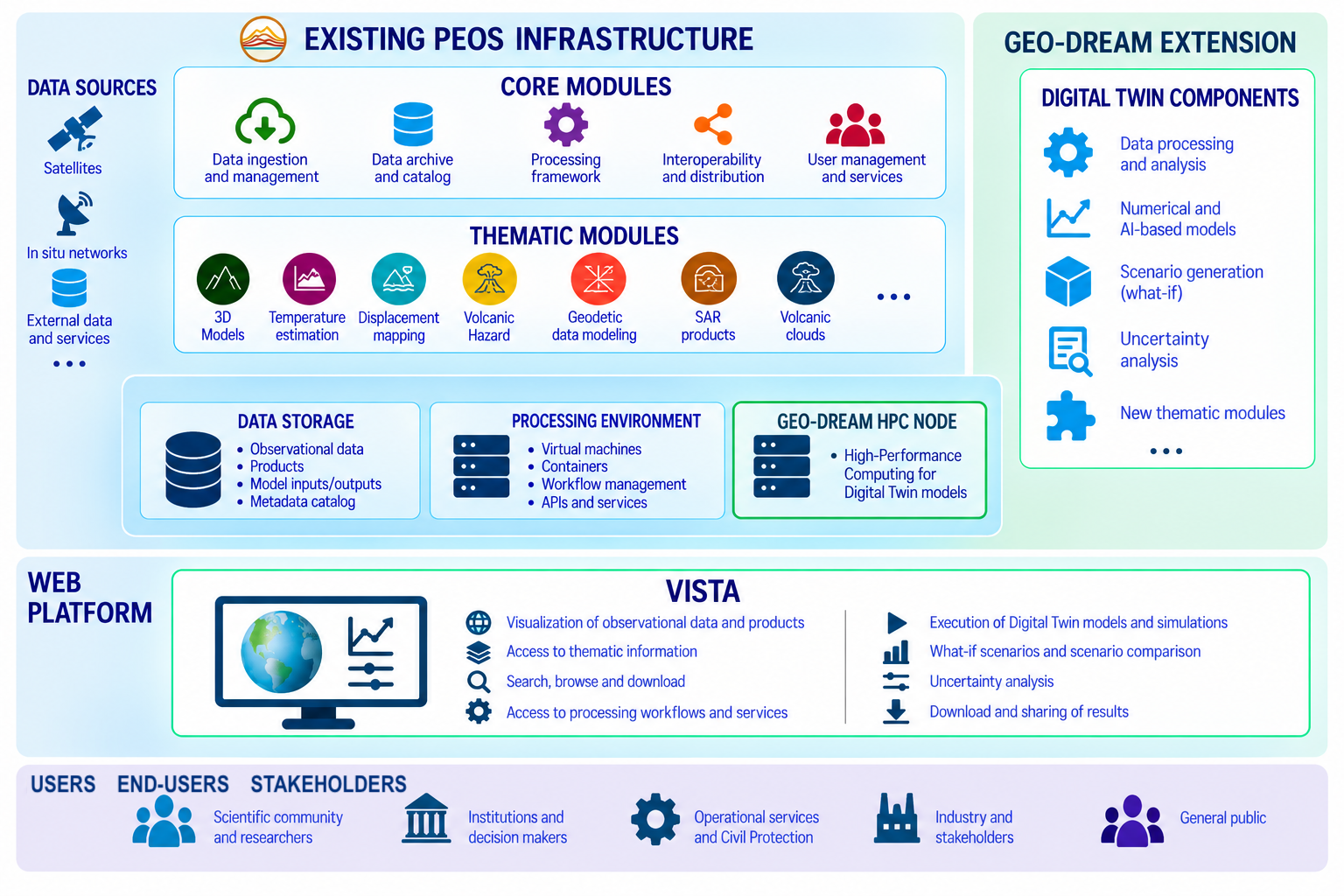
On top of this integrated data and computational infrastructure, the VISTA web platform will provide the main user-facing environment of the GEO-DREAM system. Through VISTA, users will be able to access and visualise observational data, model outputs and Digital Twin products; interact with processing and modelling workflows; execute simulations; and explore alternative scenarios through what-if experiments.